Last year I taught Freshman English. It was my first year teaching 9th grade–I usually teach Sophomores–but two of my three kids were 9th graders last year, so my school graciously offered me the opportunity to be their English teacher.
I eagerly took the job, though I must admit at first I was not looking forward to teaching Romeo and Juliet. It might be my least favorite of all of Shakespeare’s works. It is so cliché. The “love” between the two teenagers is so superficial, and through a series of terrible decisions, it results in both their deaths.
Then it occurred to me that I could teach the play from that angle. I decided to teach the play from the perspective of teenage fickleness and used it to show students that the intense feelings they experience over teenage tragedies are just a small part of their lives. I used the entire play to teach students how fickle teenagers are. I taught them how the intense feelings that they get that “their life is over” because of some teenage tragedy is just a small drop in the bucket when looked at the entirety of their lives.
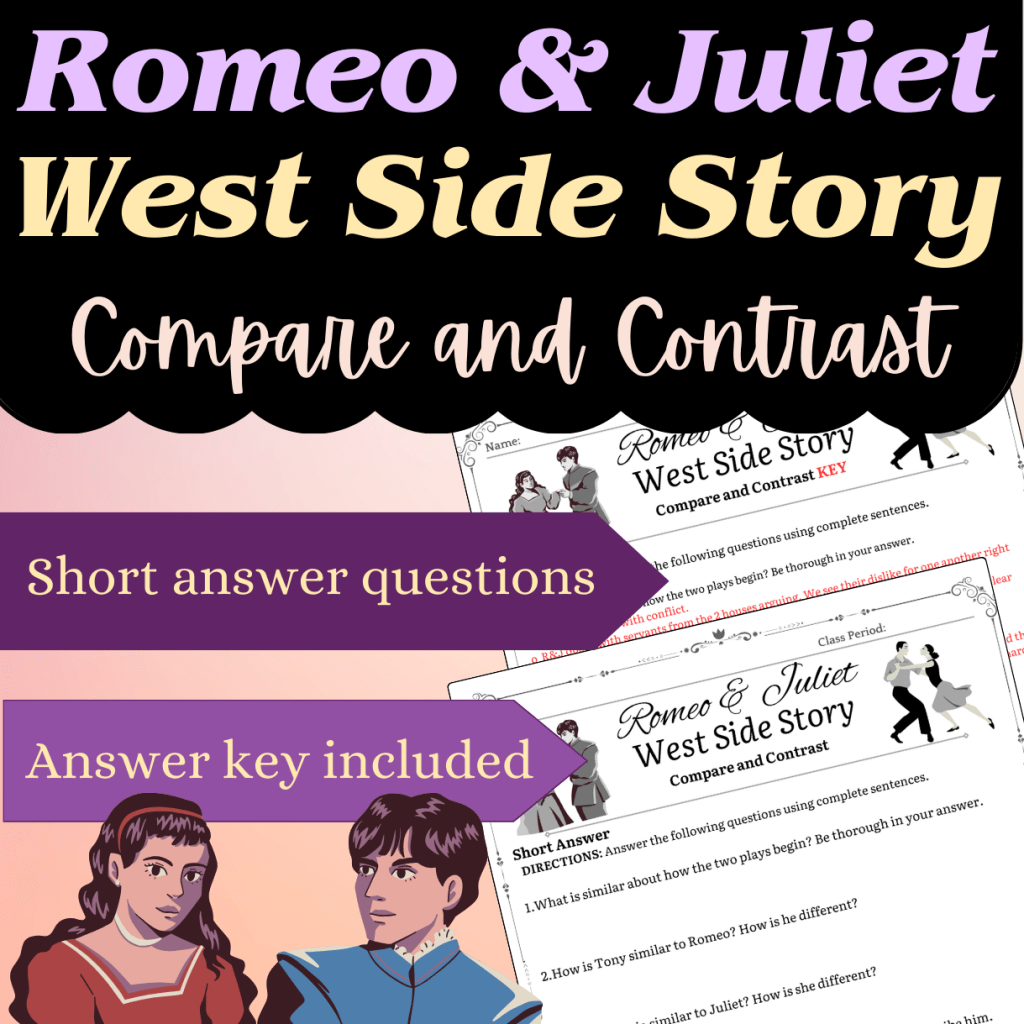
To illustrate this point, I incorporated the musical West Side Story, which was inspired by Romeo and Juliet. I provided students with a curated list of modern media, including movies, stories, books, and musicals, that have drawn inspiration from Shakespeare’s works. We then watched West Side Story in class and engaged in discussions about the similarities and differences between the two plays. Additionally, I prepared a handout with 10 essay questions comparing and contrasting West Side Story to Romeo and Juliet.
West Side Story, a 1957 musical, is a modern adaptation of Shakespeare’s Romeo and Juliet. Both works delve into the timeless themes of forbidden love, societal strife, and tragic consequences. While Romeo and Juliet is set in Renaissance Italy and revolves around the feud between the Montagues and the Capulets, West Side Story takes place in mid-20th-century New York City and focuses on the tensions between two rival street gangs, the Jets and the Sharks, addressing contemporary issues of ethnicity, immigration, and integration.
Both stories depict central conflicts driven by the animosity between two groups that challenge social norms and ultimately lead to heart-wrenching tragedy. They explore the intertwining themes of love and destiny against a backdrop of societal unrest, underscoring how deeply rooted animosities and misunderstandings can thwart individual desires and result in devastating outcomes.
West Side Story masterfully updates Shakespeare’s classic narrative to address contemporary issues of race and identity, all while preserving the core elements of tragedy and forbidden love, thus showcasing the enduring relevance of the original tale. I have found that not only do students enjoy comparing the two works, but they also benefit greatly from drawing the parallels.

 Lit and Wit with Wendy
Leave a comment